
Rethinking Death Rituals: How Personalizing Memorials Helps Us Process Grief
Learn how personalized death rituals — from funerals to simple traditions — can deepen connection, support grief, and create meaningful remembrance.
By Sarah E. Clem, MSW
“Death ritual” isn’t a term you hear every day, but chances are you’ve attended one — and you may have even helped plan one.
So, what exactly is a death ritual?
Death rituals are any gathering, practice, or activity that recognizes and memorializes a person’s death. They create space for ceremony, remembrance, and connection.
When most people think about death rituals, they imagine formal events that take place soon after someone dies — funerals, memorial services, or celebrations of life. But death rituals don’t always end when the service does. They can also include practices that continue for years: celebrating a loved one’s birthday, gathering on anniversaries, or participating in cultural traditions such as Día de los Muertos.
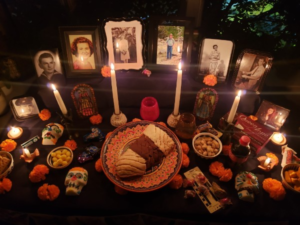
An Ofrenda, the offering placed on the altar during the annual Día de los Muertos celebration.
These rituals — large or small, formal or informal — play a powerful role in how we process loss. They help bring people together to support one another while navigating the complexities of death, and allow space for us to share our memories and emotions with others who may be coping with grief, too.
While death rituals can be incredibly cathartic events, many of us can probably think of a time when a death ritual missed the mark. My grandmother’s funeral comes to mind. For her service, my family selected a pre-prepared package – the kind that could’ve been about anyone’s nana. It was professional and respectful, but oddly impersonal.
My core memory of the funeral came when the celebrant described the nostalgic smell of my grandmother’s freshly baked apple pie. That would have been a lovely nod – if my grandmother could bake. I look back now with a giggle, but I often think about how different my family’s experience might have been if we had deeper conversations with the celebrant or taken a more active role in planning.
We learned firsthand how drastically personalization can affect a death ritual after the unexpected death of my father. When my mom, sisters and I met with the funeral home to prepare for his celebration of life, we were provided with an itemized list of their services – but we left without making any commitments, instead opting for reflection.
We asked ourselves: What would best honor our dad’s life?
Ultimately, we hosted the celebration of life two weeks later in the gymnasium of the school where he served as principal.
The service itself reflected our family and community: my eldest sister gave the eulogy, another sister offered welcoming and closing remarks, and I read the obituary. A family friend created a tribute video, while another played live music.
The funeral home still played an important role — they coordinated the cremation, printed programs, arranged seating, and livestreamed the event — but the heart of the ceremony came from the people who knew my dad best.
At the end of the service, the funeral director thanked our family for allowing him to witness what we had created.
The personalization and planning of my dad’s funeral led to unexpected and welcome benefits. Beyond the cost savings from doing things ourselves, the experience brought my family closer to each other and increased our respect for one another as we collaborated on the service.
We also noted a marked difference in quality that came from personalizing specific components of the funeral. One key example is the tribute video – it exceeded all expectations. What we thought would be a slide deck of pictures set to music became a cinematic journey through my dad’s life in photos, interspersed with video footage of my dad during a never-before-seen interview. Hearing my dad’s voice again was profoundly moving.
The same was true of my sister’s eulogy. Before writing it, she spoke with people from different chapters of my dad’s life. In doing so, she was able to capture the multifaceted nature of my dad’s legacy.
These personal touches didn’t just make the service unique – they helped us process our grief.
If this sounds like a lot of work for a family that’s grieving, there are other, more accessible ways to personalize death rituals. Many of the most meaningful rituals are informal: lighting a candle on a birthday, gathering for dinner on an anniversary, or visiting a place that holds special memories.
These rituals can emerge naturally, and be incredibly therapeutic for bereaved individuals.
After my dad died, I unintentionally created one of my own.
What started as a simple thank-you meal with a friend who supported our family in my dad’s final days turned into something much bigger. In the years following his death, I began traveling to meet people who had known my dad throughout his life. I shared meals with his colleagues, childhood friends, and mentors — people I had never met before, who knew my dad from chapters of his life I wasn’t a part of.
One of those meals wrapped up at 2 a.m. in Mumbai, India, where I listened to stories about my dad standing up to bullies as a child growing up in rural Colorado. Those conversations became a kind of pilgrimage — an ongoing effort to understand my dad through the memories of people who knew and loved him. And along the way, I formed lasting friendships of my own.
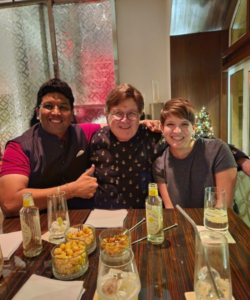
Sarah Clem celebrating her dad with friends in India.
Death rituals don’t require travel across oceans, though. My mom created a meaningful ritual where she invites family and close friends to gather each year on the anniversary of my dad’s death. We gather in our collective grief, reflect on memories of my dad, and express our gratitude at knowing him and one another. We even make sure to call those who cannot be physically present, so no one has to grieve alone.
These gatherings remind us of an essential benefit of death rituals: they provide space for ongoing “grief work” long after a death event. Because grief does not end when the funeral is over.
By engaging in informal death rituals, we can honor our grief as it evolves over time by continuing to hold space for it in the years following our losses. Informal death rituals allow us to find support through remembrance.
Because these events are most effective when shared, it’s important to include everyone touched by loss. For instance, young children or individuals with developmental disabilities may be left out of ceremonies. Loved ones who live far away may struggle to attend due to travel costs, work schedules, or childcare responsibilities.
When planning rituals — formal or informal — it can be helpful to pause and ask: Who might benefit from participating?
The beauty of personalized rituals is that they can adapt to meet the needs of the people who need them most.
If there’s one takeaway from this reflection, I hope it’s this: Death rituals don’t have to be elaborate to be meaningful. But they do benefit from intention. Whether you’re planning a funeral, organizing a memorial gathering, or simply lighting a candle each year, these moments create space to hold grief and memory together. They give you an opportunity to wrap your arms around both your grief and your loved ones, and honor your loved ones as life moves forward.
So, personalize your rituals — big or small, formal or informal — however feels right for you. Your grief will thank you for it.